
History of the Selkʼnam
Around 10,000 years ago the Selkʼnam or Ona people moved down from the mainland to the island of Tierra Del Fuego at the southern tip of South American. Folklore states that the tribe arrived by land but were unable to return north as the ocean, over the course of a thousand year, flooded the crossing creating the Strait of Magellan. Six hundred and twenty miles from Antarctica and often called the End of the World, the region remains inhospitable with constant wind; short, cool summers; and long, cold wet winters. Fauna and flora were abundant, however, with plenty of marine life, birds, guanaco, fox, rodents (tuco tuco) and a variety of edible plants. Guanaco, related to the llama, was the prime source of food and clothing and were hunted using bow and arrow and bolas. Each family unit was its own tribal group and all were nomadic hunter-gatherers. They lived in temporary camps for a few days to weeks depending on food sources. Larger long-term buildiings that housed up to three families and resembled teepees were built in the forest where wood was plentiful. They also built this structure for their sacred Hain ceremonies. Short-term constructions were quickly built as smaller windbreakers, or low-profile tents that were constructed out a few branches with several animal hides. These could be found on the plains shaped as an open semi-circle or a closed shell depending on the weather.
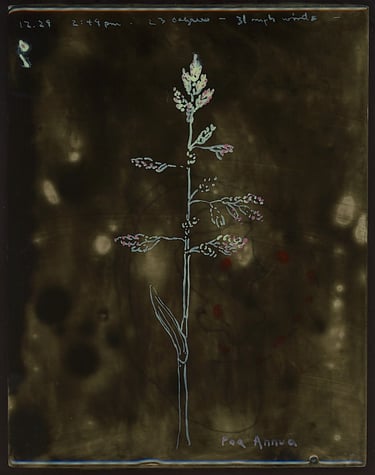
The close-knit family shared all chores with men being responsible for hunting for food, providing clothing,d and assembling housing while the women provide all domestic duties and gathered eggs, plants (Ribes magellanicum (parrilla), Empetrum rubrum, Poa annua ) and mollusks. Sea lions and whales were plentiful and when they were found beached, several families would share this fortune.
The Selk’nam had a complex social organization that included myths, legends, rites and ceremonies. They worshiped a divine spirit that encompassed all the land and believed that they would become part of the environment when they died. They worshipped privately and believed that Hain was one of their most important rituals. This was a rite of passage for males where the participants colored their bodies in red and white pigment using soils/clay, charcoal, and crushed bone bound with saliva, and animal grease. The elders would create various shaped headdresses to call the deities to the complex ceremonies which would last a few days. The actual passage from adolescence to manhood might take as long as a year, however, due to the amount of information and skills that needed to be passed on. The young male would then start their own family with a female from another region or “sky”. The island was divided into
four skies. Each sky had their own group of families that would meet occasionally to trade, for important ceremonies or to mark deaths.


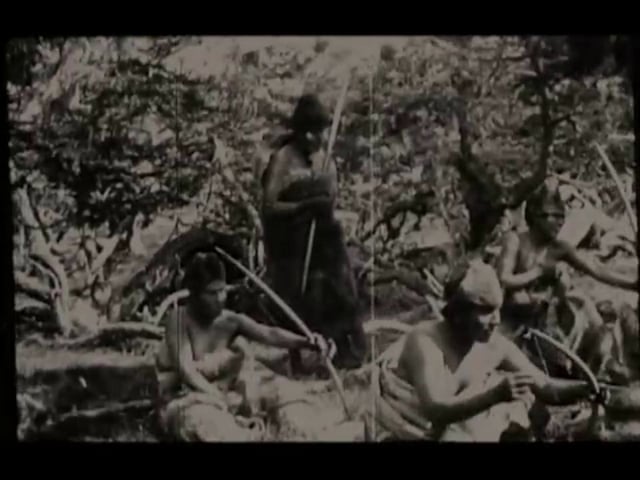
This film was filmed in the 1930s by Father Alberto Maria de Agostini ( among the Selk'nam of Tierra del Fuego and was edited by Francisco Gallardo.
Alberto Rey, Where the Fire Ends: Poa annua plant. Epoxy, ink, oils, 2026
1907 Map of Tierra Del Fuego, South America, Stanford's Geogragraphical Establishment, London, England
After flourishing uninterrupted in their harsh landscape for thousands of years, by the end of the 1800’s, Selkʼnam’s would find much of their population and culture eradicated. In a matter of a few decades, due to a gold rush and a boom in sheep herding, contact with Europeans increased dramatically. By this point, however, the introduction of European diseases through contact with sailors, traders, and sealers had already begun. Outbreaks of smallpox, measles, influenza, pneumonia, and syphilis spread quickly with over 50% mortality rates found in certain tribes. Chilean and Argentine governments had granted large swaths of land to gold miners and ranchers which in turn disrupted 80% of the native people’s hunting grounds. The Selkʼnam did not understand the concept of private land and hunted sheep as a substitute for their prized guanaco which were no longer available. The ranch owners retaliated by creating a bounty system that they publicized in newspapers to recruit armed militia to hunt down and kill the Selkʼnam. They would pay 1-10 pesos (domestic servants were making around 10 pesos a month) for a pair of Indigenous ears, hands, breasts, men’s genitals, a scalp, a head or a uterus. Women’s body parts were paid 50% more. Women were also repeatedly raped and forced to marry non-natives.
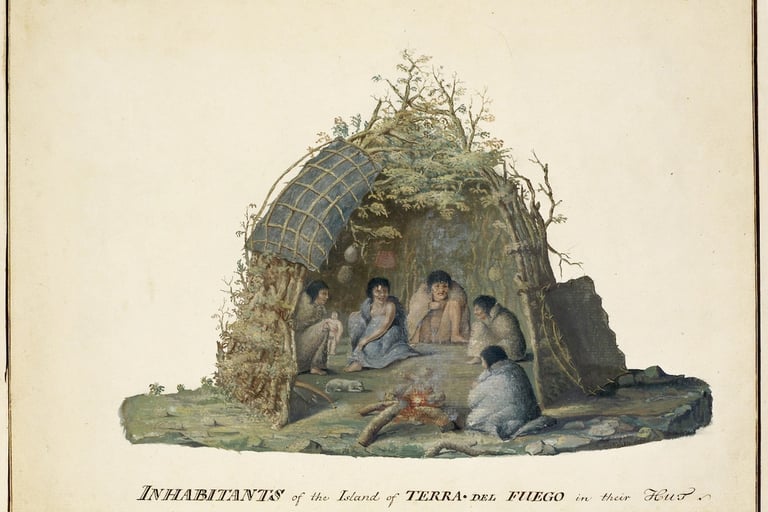
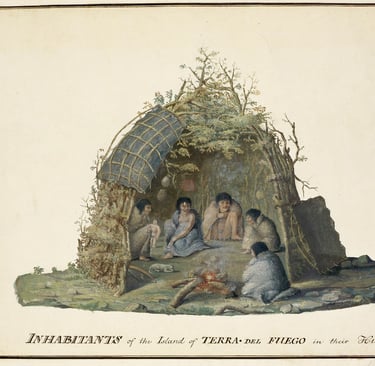
Inhabitants of Tierra del Fuego, Alexander Buchan, 1769 James Cook Expedition.
Newspapers started to uncover the extent of the genocide as Salesian missionaries, sent to the region to convert and assimilate the remaining tribe members, became more vocal, about what they were witnessing. Unbeknown to the priests, however, was that their own missions were creating the ideal conditions for the spread of tuberculosis, influenza, pneumonia, measles, and scarlet fever. Missionaries worked to document and preserve the Selkʼnam culture and language although went as far as to study tribe members who had been abducted and exhibited in circuses. Over time, the indigenous population in the missions dropped dramatically and the missions were closed.
Argentine and Chilean authorities conducted sporadic inquiries into the mass killings in the early 1900’s, but no legal actions were taken. As the Indigenous populations started to bottom out, missionaries and photographers, Martin Gusinde and Alberto Maria de Agostini, photographed and filmed what remained of the last Selk'nam rituals and ceremonies.
The few Selk'nam who survived were the ones who found livelihoods outside the missionaries. The Chilean government considered these Indigenous people officially extinct in 1950 even though Ángela Loji, the last full-blooded Selk'nam who had spent her childhood in the tribe, remained alive. She spent most of her life providing documentation about tribal rituals, customs, chants and language until her death in 1974. Some questioned if this now marked the extinction of the tribe without considering the validity of mixed-race tribal members. It wasn’t until 2023, that Chile's National Congress recognized the Selk'nam as one of the country's 11 original indigenous peoples which provided for political and legal recognition.


One of the more infamous gold miners was, Julius Popper, an engineer and photographer, who launched expeditions from 1889-93 which were authorized by Argentina's Interior and War Ministries. He mapped parts of the island, mined for gold and killed over a 100 Selk'nam. He and his soldiers posed next to bodies which he staged to compose his photographs. He later created albums of these photographs that he presented to his supporters and made presentations with his photographs to secure additional funding for his expeditions. These expeditions in combination with rancher’s militias, which were supported by the Argentine and Chilean governments, reduced the Selk'nam population from an estimated 4,000 to under 100 in 30 years. The cost of eliminating the Selk'nam was cheaper than negotiating land use.
© "Colección Museo Regional de Magallanes" , Julian Popper Expedition Album
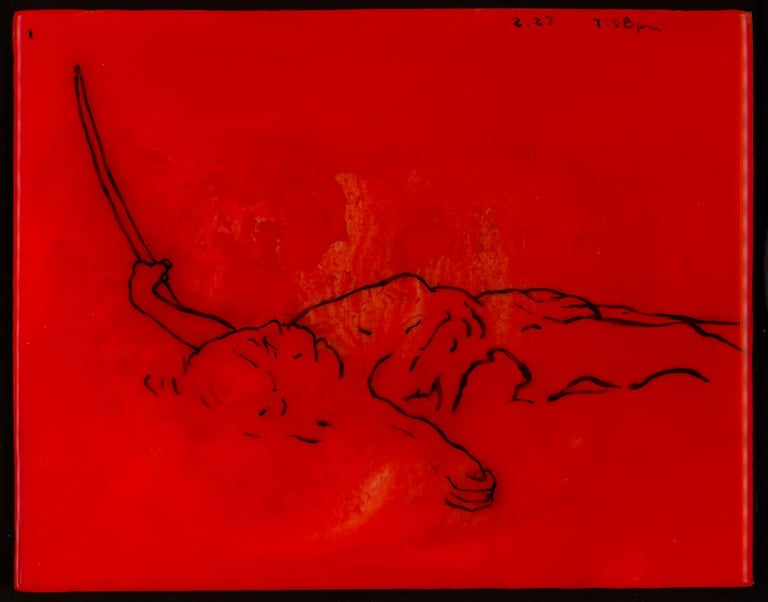
Alberto Rey, Where the Fire Ends: Julian Popper's Staged Murder Scene of a Selk'nam , Epoxy, ink, oils, 2026
It was during one of these deaths that Tierra del Fuego ('Land of Fire') was named. In 1520, Ferdinand Magellan, who named the region, sailed into the strait that separates the mainland from the island. He was looking for a shortcut between the Atlantic and Pacific Oceans. The longer voyage around the southern tip of the continent was fraught with gale-force winds and icebergs from Antarctica. As he sailed close to the island, he saw fields on fire. He did not realize that the Selk’nam set fields on fire to mark the death of an important family member and to pass the news on to nearby tribes.
The Selk’nam’s first contact with Europeans was an uneventful encounter with the Sarmiento de Gamboa expedition in 1580, but, in 1599, a hostile encounter with Olivier van Noort’s Dutch fleet would mark the first of many hostile encounters with Europeans. This meeting would leave forty of the tribe members dead. James Cook would land on the island over a century later in 1769 with an artist and botanist who recorded the island’s inhabitants and environment. Robert Fitzroy on the HMS Beagle in 1830 took four indigenous tribe members back to England to show the King and Queen. Three survived the voyage and were returned a couple years later by Charles Darwin.